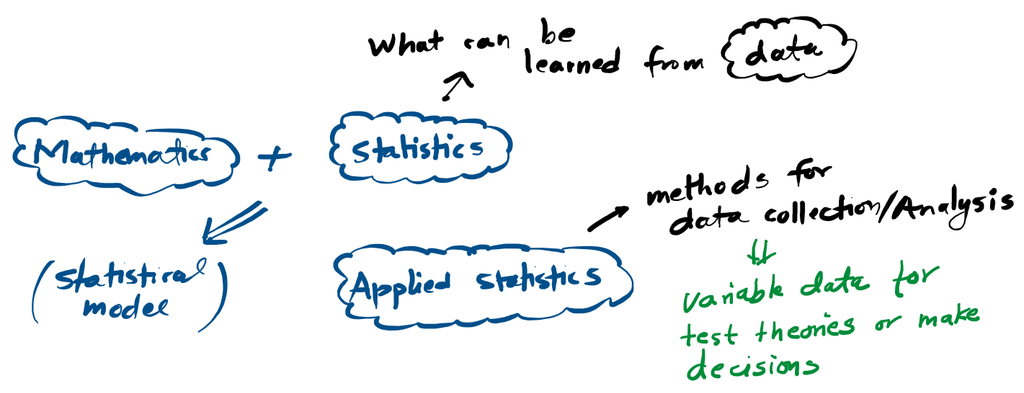
Statistical modeling is the process of applying mathematical formulations to describe the underlying probability distributions and relationships that generate a set of data. It provides a formal framework to represent both the predictable, systematic patterns in data and the inherent, random variability, often referred to as noise.
Core Elements
1. Variables
The data points being observed, typically divided into response variables (the outcome) and explanatory variables (the factors that influence the outcome).
Visual: Blue Dots
2. Parameters
Unknown constants within the model that are estimated from the observed data to quantify the exact relationships between variables.
Visual: Solid Red Line
3. Probability Distributions
Mathematical functions that describe the likelihood of observing different values, allowing the model to explicitly account for uncertainty and scatter.
Visual: Purple Shaded Uncertainty Band
Goals: Inference & Prediction
Understanding how variables interact (inference) and forecasting future observations (prediction). Unlike deterministic models, statistical models embrace uncertainty to draw quantifiable conclusions.
Visual: Dashed Orange Line (Future)