Multi-Objective Optimization is an interesting approach where instead of focusing on one objective we simultaneously try to minimize or maximize more than one objective function.
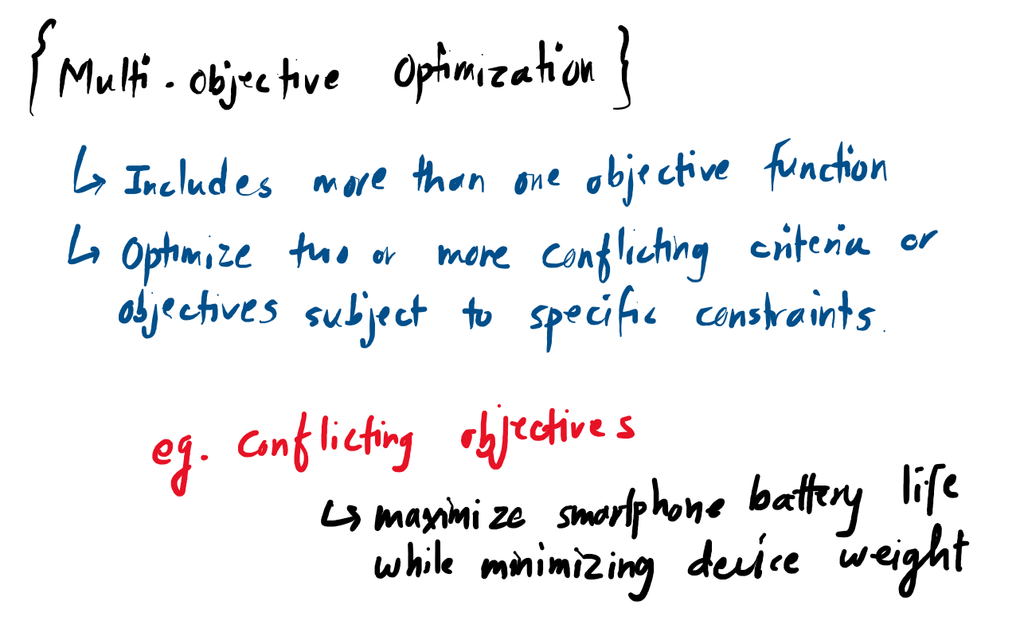
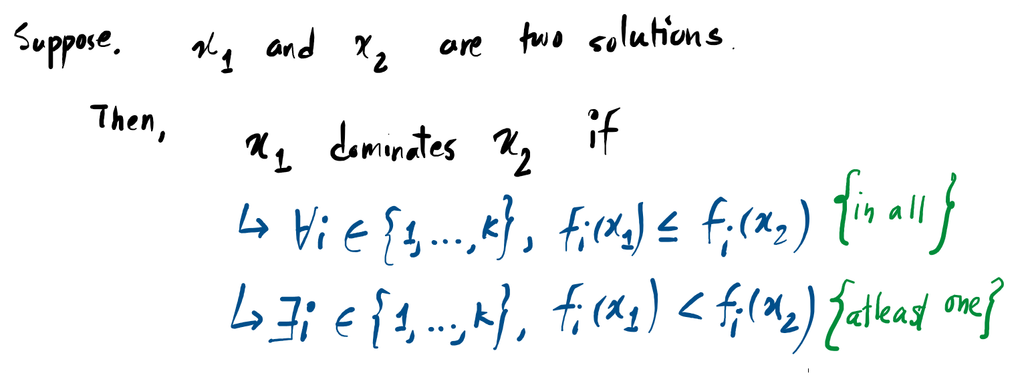
The objective functions are conflicting in multi-objective optimization problem because a single solution doesn’t optimize each objective simultaneously. Thus, the solution in multi-objective function is called nondominated or pareto optimal and is determined by the dominance. This is in contrast to single objective problem where whether solution is better or not is determined by comparing the objective values.
Mathematically, we can formulate multi objective optimization problem as:
$$\min_{x\in X} f_k(x)$$ where, $k=1,2,…,K$
Dominance: How good is the solution?
Pareto Optimality:
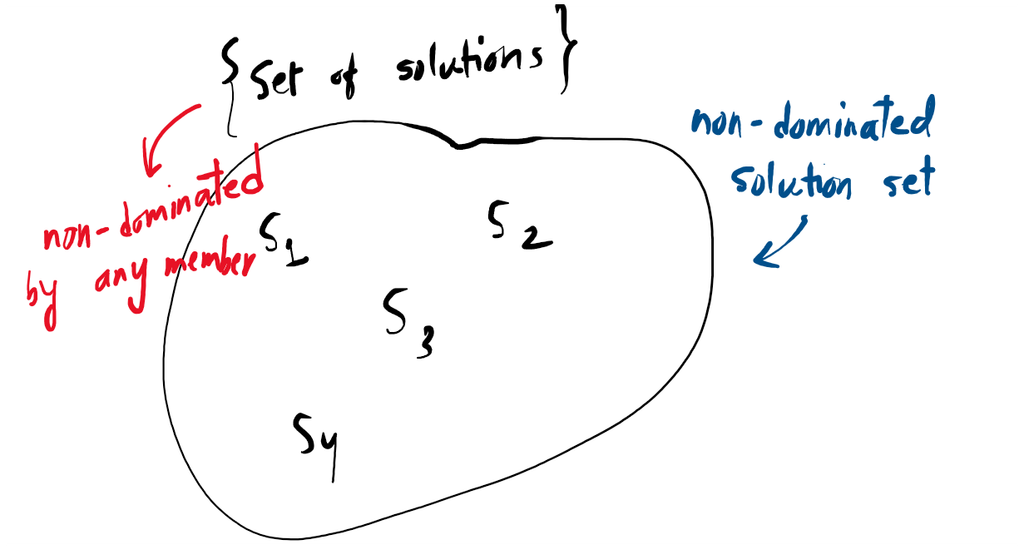
In multiple objectives scenario, how can we define if a point is optimal? For this purpose, we use concept called Pareto Optimality in multiobjective optimization. A point is nondominated if no other points dominates it in the entire domain and is called Pareto Optimal whereas the set of all pareto optimal points is called Pareto set.
References:
[1] “Lecture 9: Multi-Objective Optimization.” [Online]. Available: https://engineering.purdue.edu/~sudhoff/ee630/Lecture09.pdf
[2] J. R. R. A. Martins and A. Ning, “Multiobjective Optimization – Engineering Design Optimization,” Github.io, 2022. https://mdobook.github.io/html/multiobj/
[3] “Multi-objective optimization – Wikipedia,” Wikipedia.org, 2018. https://en.wikipedia.org/wiki/Multi-objective_optimization