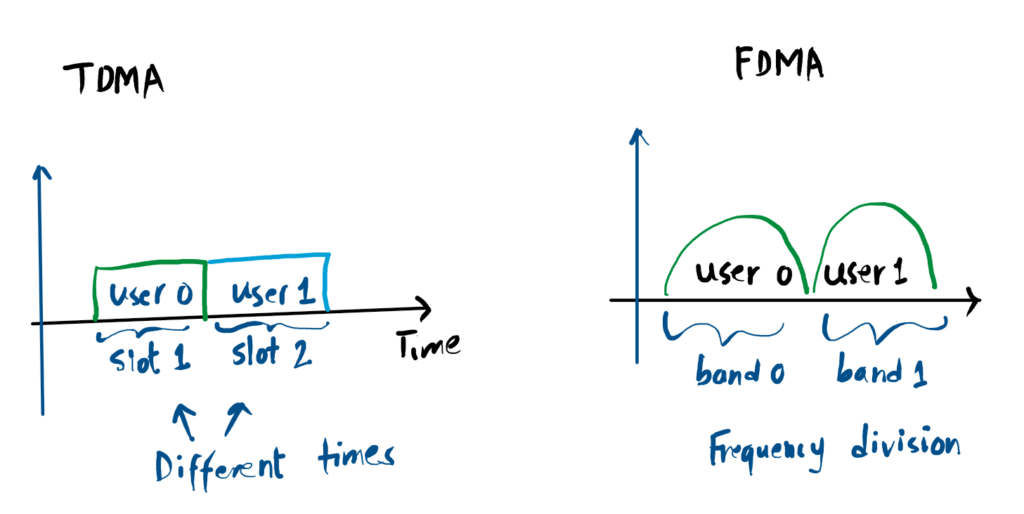
Multiple Access is done using TDMA, FDMA and CDMA.
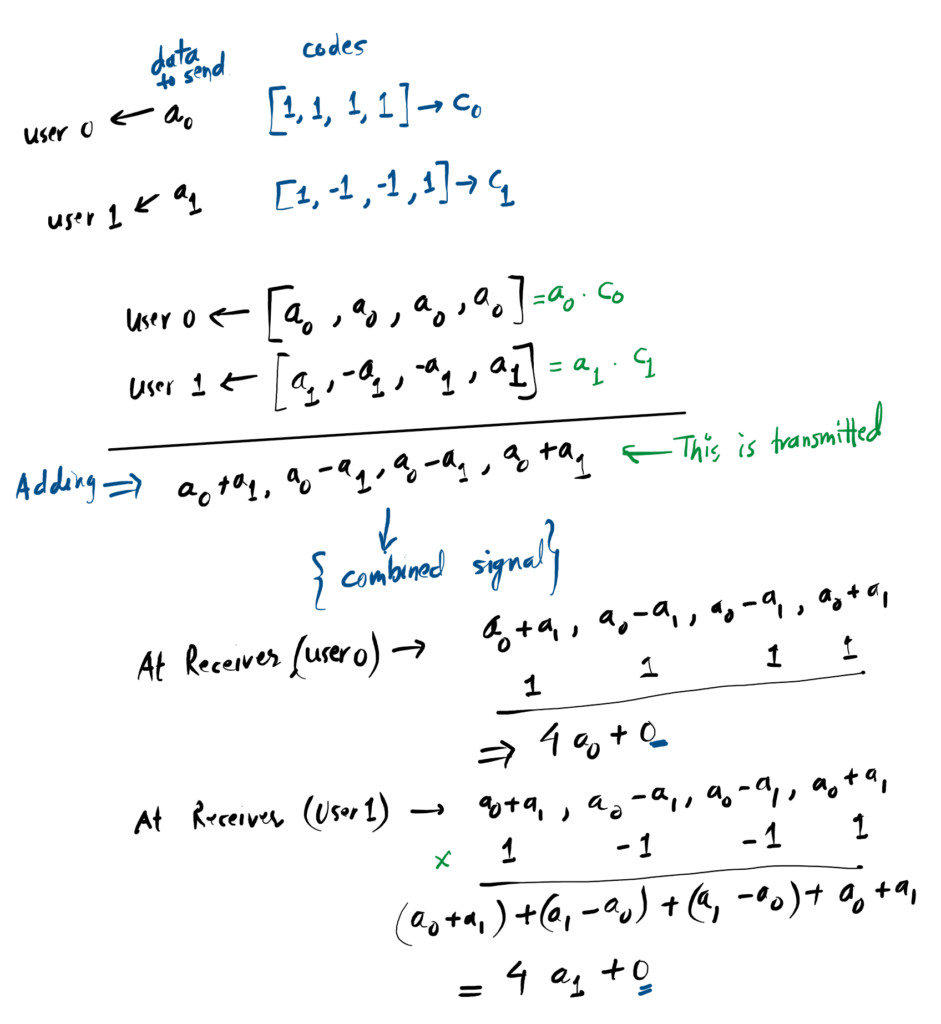
CDMA is also multiple access technology. Example below show two users User 0 and User 1. a0 and a1 are data to be sent to users 0 and 1 respectively. Codes C0 is for User 0 data and C1 is for User 1 data.
The key operations are:
- Multiplying with code
- Combining signals of all user
- Recovering the correct symbol correctly (Correlating with the code)
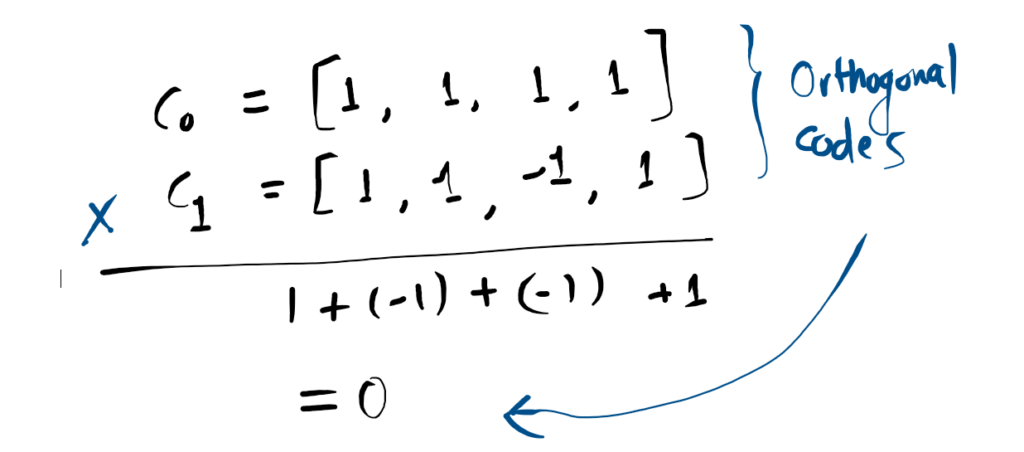
Codes are orthogonal as,
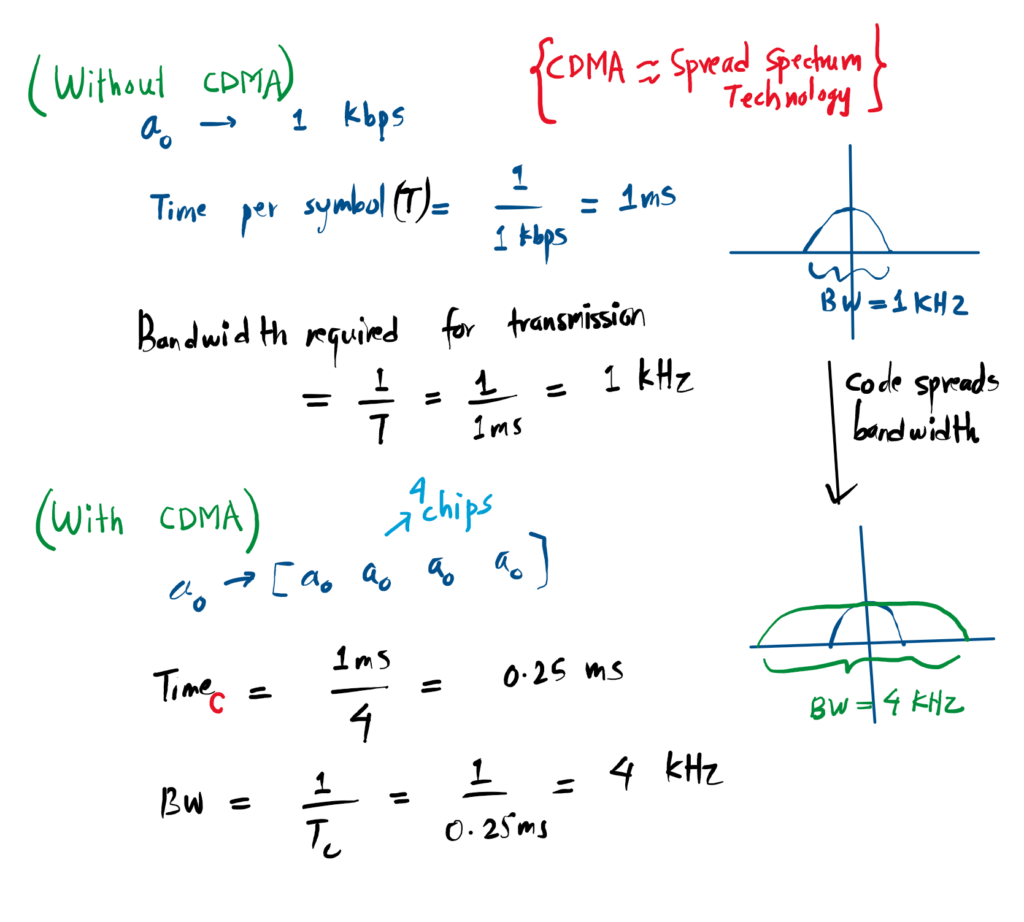
Spreading Impact (Bandwidth Spreads)
CDMA is also known as spread spectrum technology because it spreads the bandwidth. The codes are also known as spreading codes.
Below example shows CDMA walsh code.
CDMA Walsh Code
Visualizing Spreading, Multiplexing, and AWGN Noise.
LFSR is also technique to generate codes of longer length.
CDMA Mechanics
Beyond basic spreading: Synchronization, Power Control, and Handoffs.
Perfect Orthogonality
Uses strict mathematical codes (like Walsh Functions). Cross-correlation is exactly zero, meaning users do not interfere with each other at all. However, it requires precise timing coordination, usually handled by a centralized base station.
Pseudo-Random Noise (PN)
Uses LFSR (Linear Feedback Shift Registers) to create codes that appear random. It doesn’t require strict timing (great for moving mobile phones), but introduces slight Multiple Access Interference (MAI) because the codes aren’t perfectly orthogonal.
The Near-Far Problem & Power Control
If a close phone and a distant phone transmit at the same power, the close one will drown out the distant one. CDMA networks use rapid Closed-Loop Power Control (up to 800 times a second) to force nearby phones to “whisper” and distant phones to “shout.”
Universal Frequency Reuse & Soft Handoff
In older FDMA/TDMA networks, adjacent cell towers had to use different frequencies to avoid interference, resulting in a “Hard Handoff” (break-before-make) when driving between them. Because CDMA relies on codes instead of frequencies, every cell tower uses the exact same frequency band. This allows a phone to seamlessly connect to two towers at once (a “Soft Handoff” or make-before-break), dramatically reducing dropped calls and improving overall signal reliability via Rake Receivers.