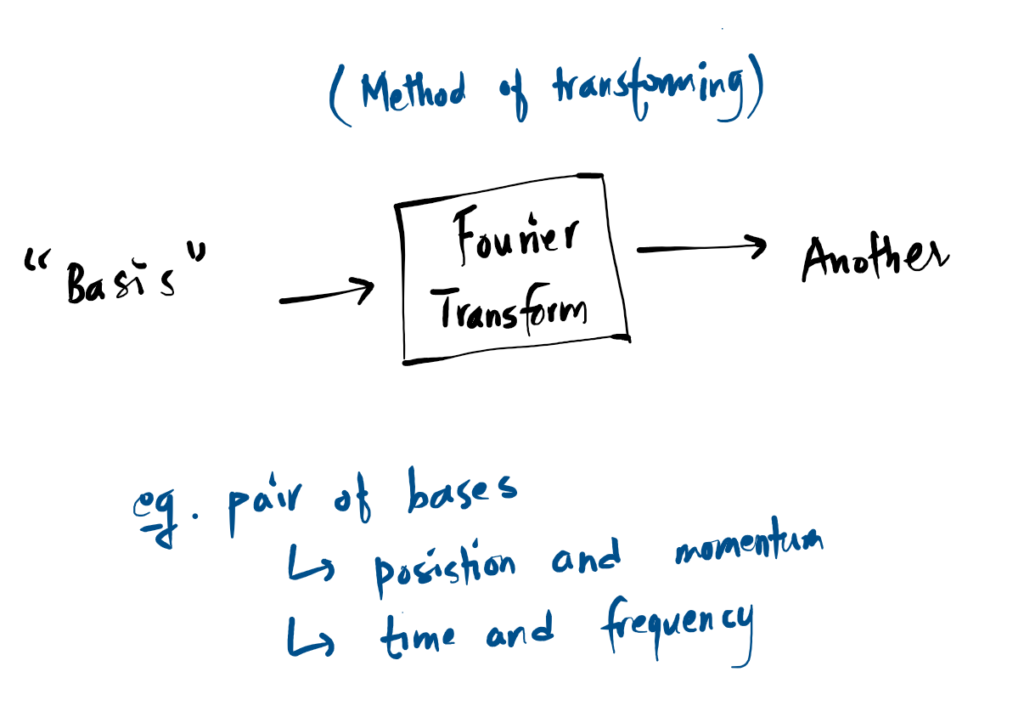
Fourier Transform – A method of transforming from one basis to another. Pair of bases can be position and momentum or time and frequency.
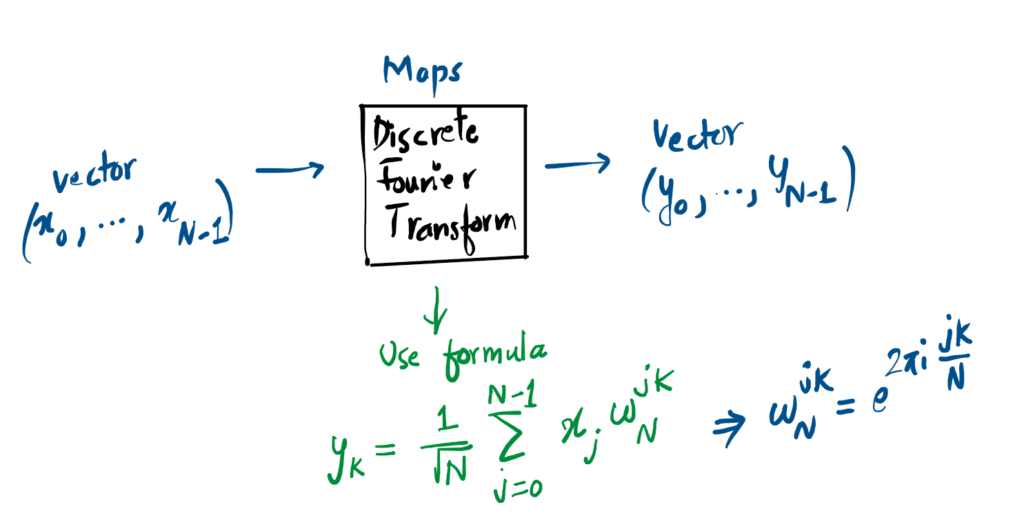
Discrete Fourier Transform – While fourier transform is useful for signal processing applications, for real world application contexts, we usually want to transform a discrete set of data points, not a continous function. For this, we use discrete fourier transform.
Fourier transform is in basic way to represent a discrete function into linear combinations of new of set of its contituent periodic functions (“basis functions”) with each with period $\frac{N}{k}$.
Quantum Fourier Transform
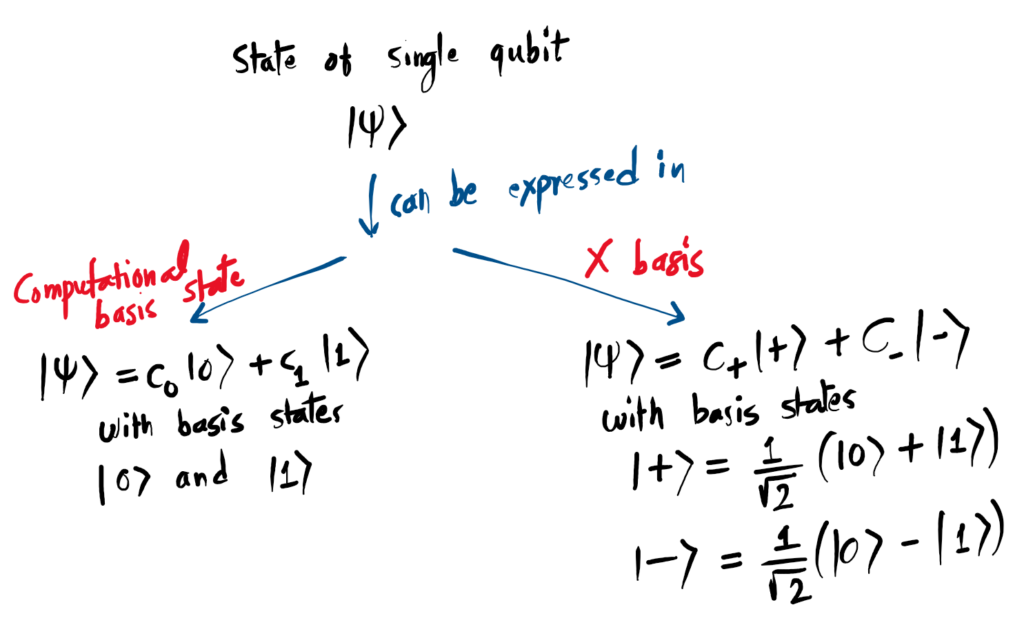
State of a qubit can be expressed in computation basis $|\psi\rangle = c_0 |0\rangle + c_1|1\rangle$ with basis states $|0\rangle$ and $|1\rangle$. It can also be expressed in $X$ basis $|\psi\rangle = c_+|+\rangle + c_-|-\rangle$ with basis states $|+\rangle = \frac{1}{\sqrt{2}}(|0\rangle + |1\rangle)$ and $|-\rangle = \frac{1}{\sqrt{2}}(|0\rangle – |1\rangle)$.
Now to express qubit states in the Fourier basis, a state can be expressed in terms of a linear combination of the Fourier bases states $|\phi_y\rangle$ instead of of usual computational basis states, $|x\rangle$. To do this, we apply quantum fourier transform (QFT) as,
$|\phi_y\rangle = \frac{1}{\sqrt{N}} \sum_{x=0}^(N-1) w_N^{yx}|x\rangle$ where,
$w_N^{yx} = e^{\frac{2\pi iyx}{N}}$
Resources:
“Quantum Fourier transform | IBM Quantum Learning,” IBM Quantum Learning, 2026. https://quantum.cloud.ibm.com/learning/en/modules/computer-science/qft
G. Alonso, “Intro to Quantum Fourier Transform,” PennyLane Demos, Apr. 16, 2024. https://pennylane.ai/qml/demos/tutorial_qft
C. to, “change of basis applied in quantum computing,” Wikipedia.org, July 22, 2004. https://en.wikipedia.org/wiki/Quantum_Fourier_transform