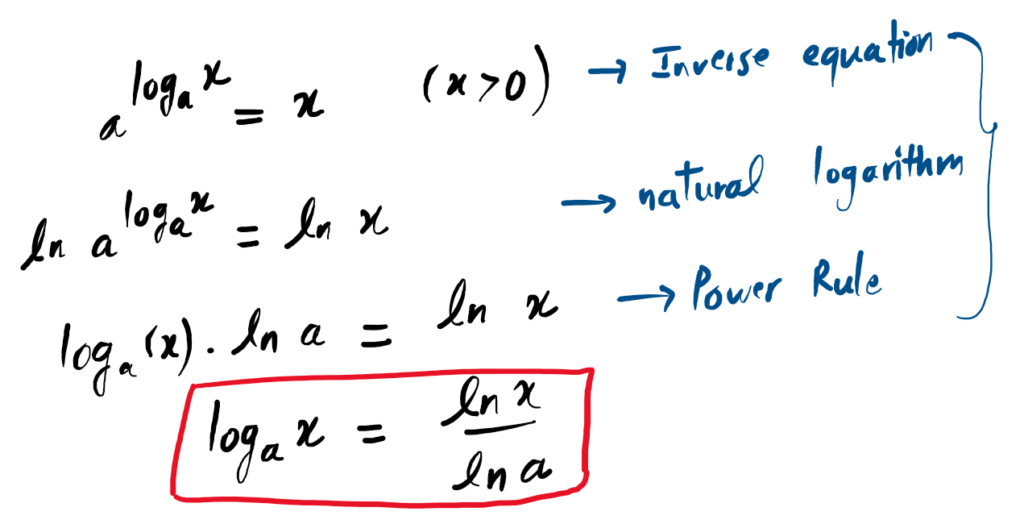
In calculus, exponential functions with a base other than e (like ax) and logarithms with base a (like loga x) are handled by converting them into their “natural” forms.
Since the natural exponential ex and natural log ln(x) have very simple derivatives, we use them as the bridge to understand ax and loga x.
Interactive Visualization: Changing Base a
Move the slider to see how changing the base alters the curve compared to the natural base e.
1. The General Exponential Function: ax
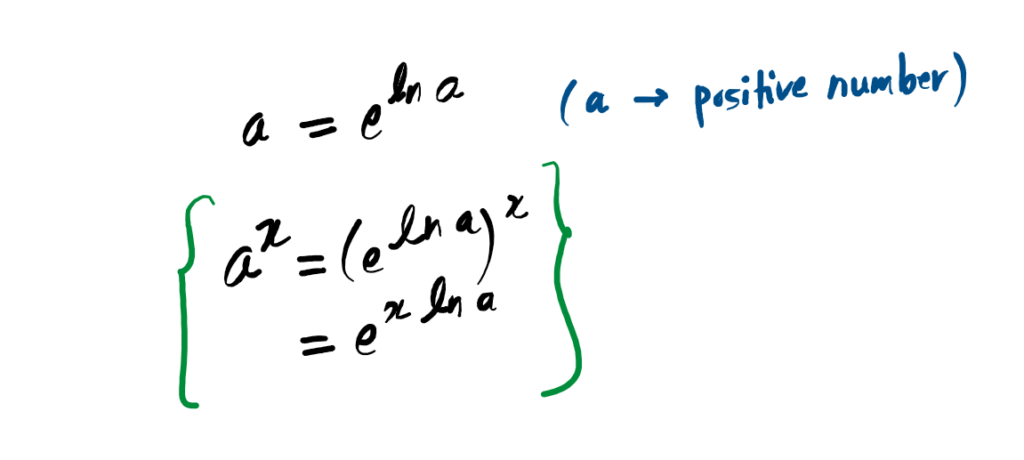
To work with ax in calculus, we rewrite it using the identity a = eln a. This gives us:
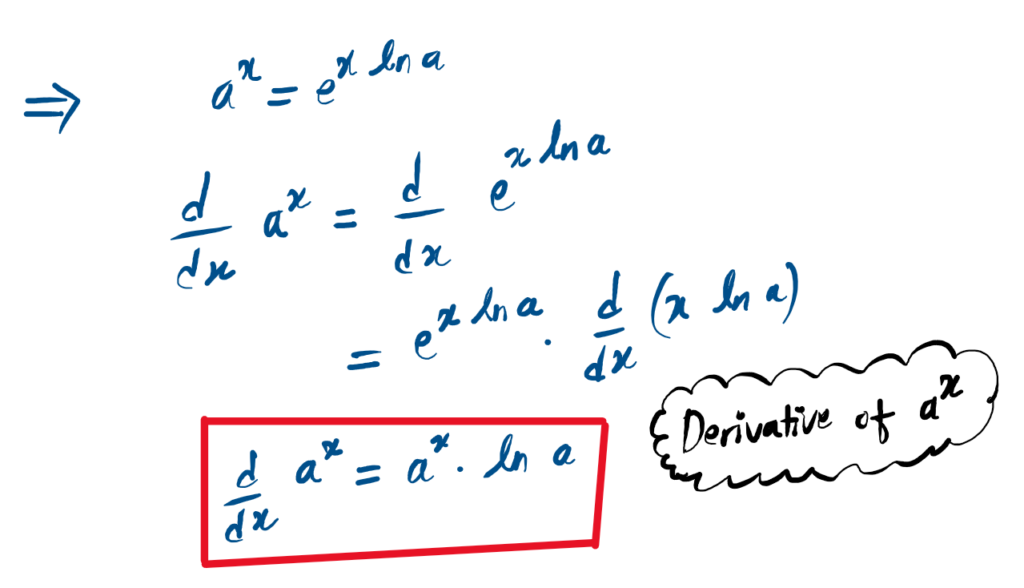
The Derivative
Using the Chain Rule on ex ln a, where ln(a) is just a constant:
2. The General Logarithmic Function: loga x
For logarithms with base a, we use the Change of Base Formula to convert the expression into natural logarithms:
The Derivative
Since 1 / (ln a) is a constant, we only need to differentiate ln(x):
The function of $a^x$:
The Derivative of $a^x$:
The evaluation of $log_a x$: