In wireless communication, modulation is the process of encoding information into a carrier wave by varying one or more of its properties.
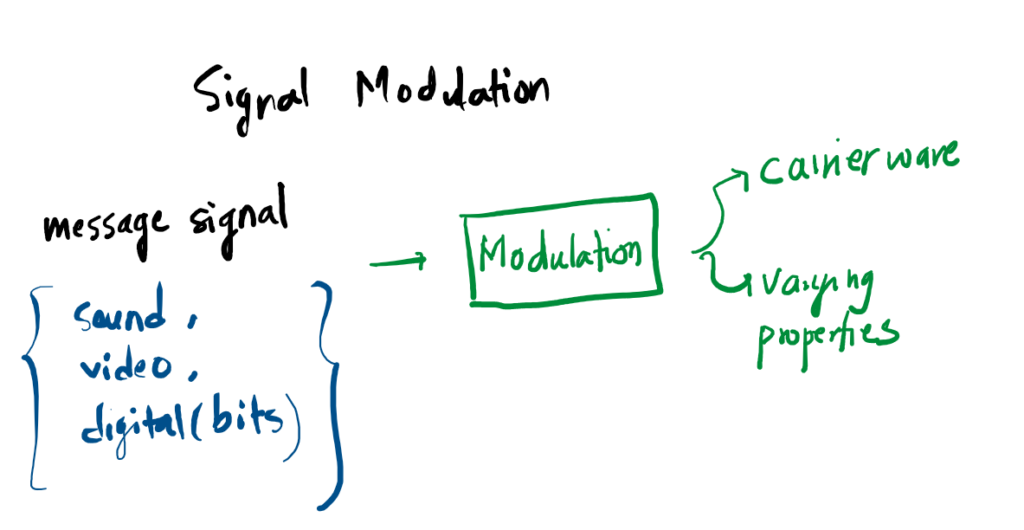
The various types of modulation can be categorized into analog, digital, and spread spectrum modulation.
Analog
Digital
Spread Spectrum
Types of Modulations
1. Analog Modulation
While mostly replaced by digital systems in modern cellular networks, analog modulation is still the foundation of radio and television broadcasting.
Amplitude Modulation: The amplitude of the carrier wave is varied in proportion to the message signal. It is simple but highly susceptible to noise.
Frequency Modulation: The frequency of the carrier is changed. It offers much better sound quality and noise immunity than AM.
Phase Modulation: The phase of the carrier is varied. While less common in pure analog form, it is the basis for many digital techniques.
2. Digital Modulation
Digital modulation is the standard for modern wireless (4G, 5G, Wi-Fi). It involves “keying,” where the carrier is shifted between discrete states to represent binary bits (0 and 1).
Basic Techniques
Amplitude Shift Keying: Bits are represented by changes in the carrier’s amplitude.
Frequency Shift Keying: The carrier switches between two or more frequencies.
Phase Shift Keying: The phase of the carrier is shifted. Common versions include BPSK (2 phases) and QPSK (4 phases).
Advanced Hybrid Techniques
Quadrature Amplitude Modulation: This combines both amplitude and phase changes to pack more data into the same bandwidth. For example, 256-QAM (used in high-speed Wi-Fi) can transmit 8 bits per symbol.
Orthogonal Frequency Division Multiplexing: Rather than using one high-speed carrier, OFDM splits the data across many closely spaced, overlapping sub-carriers. This is the “secret sauce” behind LTE and 5G.
3. Spread Spectrum Modulation
These techniques spread the signal over a much wider bandwidth than required, making the communication more secure and resistant to interference.
Direct Sequence Spread Spectrum: Each bit is replaced by a high-speed code (Chipping code). This is a core component of CDMA (Code Division Multiple Access) technology.
Frequency Hopping Spread Spectrum: The carrier “hops” rapidly across different frequency channels in a pre-determined pseudo-random pattern. This is famously used in Bluetooth.
Comparison Table
| Type | Complexity | Noise Resistance | Primary Use Case |
|---|---|---|---|
| Analog | Low | Low | Broadcast Radio (AM/FM) |
| Digital | Medium | High | Cellular (4G/5G), Wi-Fi |
| Spread Spectrum | High | Excellent | Military, Bluetooth, CDMA |
AM, FM, ASK and FSK
Amplitude Modulation (AM)
The carrier amplitude varies proportionally with the message signal.
AM
AnalogFM
AnalogASK
DigitalFSK
DigitalASK, FSK and PSK modulations
Digital Modulation Keying
Real-time comparison of Amplitude, Frequency, and Phase shift techniques.
QAM and OFDM
https://en.wikipedia.org/wiki/Quadrature_amplitude_modulation
https://en.wikipedia.org/wiki/Orthogonal_frequency-division_multiplexing
Advanced High-Speed Modulation
Modern wireless networks (Wi-Fi 6, 5G) abandon simple single-state modulation in favor of dense, mathematically complex combinations to maximize data throughput.
16-QAM Constellation
Quadrature Amplitude Modulation maps data to points on an I-Q grid, altering both the amplitude (distance from center) and phase (angle) of the carrier wave simultaneously.
OFDM Multiplexing
Orthogonal Frequency Division Multiplexing splits a high-speed data stream across multiple overlapping, slower subcarriers. The bottom white line is the physical wave transmitted over the air.
DSSS and FHSS
Spread Spectrum Technologies
Instead of transmitting on a single, narrow frequency, spread spectrum techniques scatter the signal across a wide bandwidth. This renders the transmission highly secure, resistant to jamming, and allows multiple users to share the same airwaves invisibly.
DSSS Direct Sequence
A slow data bit is mathematically multiplied by a high-speed "Chipping Code" (Pseudo-Noise). This smears the signal across a wide frequency band. Assigning unique chipping codes to different users is the foundation of CDMA (Code Division Multiple Access) systems.
FHSS Frequency Hopping
The carrier wave rapidly leaps across dozens of different frequency channels in a pseudo-random sequence known only to the transmitter and receiver. This technique, originally patented by actress Hedy Lamarr for WWII torpedoes, is the core of modern Bluetooth.
References
- "Wireless Fundamentals: Modulation," Cisco Meraki Documentation, Oct. 05, 2020. [Online]. Available: https://documentation.meraki.com/.../Wireless_Fundamentals:_Modulation.
- "Signal modulation – process of encoding information by varying properties of a periodic carrier waveform," Wikipedia.org, Dec. 02, 2001. [Online]. Available: https://en.wikipedia.org/wiki/Signal_modulation.
- "AM, PM and FM modulation," Bharath Institute of Higher Education and Research. [Online]. Available: https://www.bharathuniv.ac.in/.../AM,-PM-and-FM-modulation.pdf.